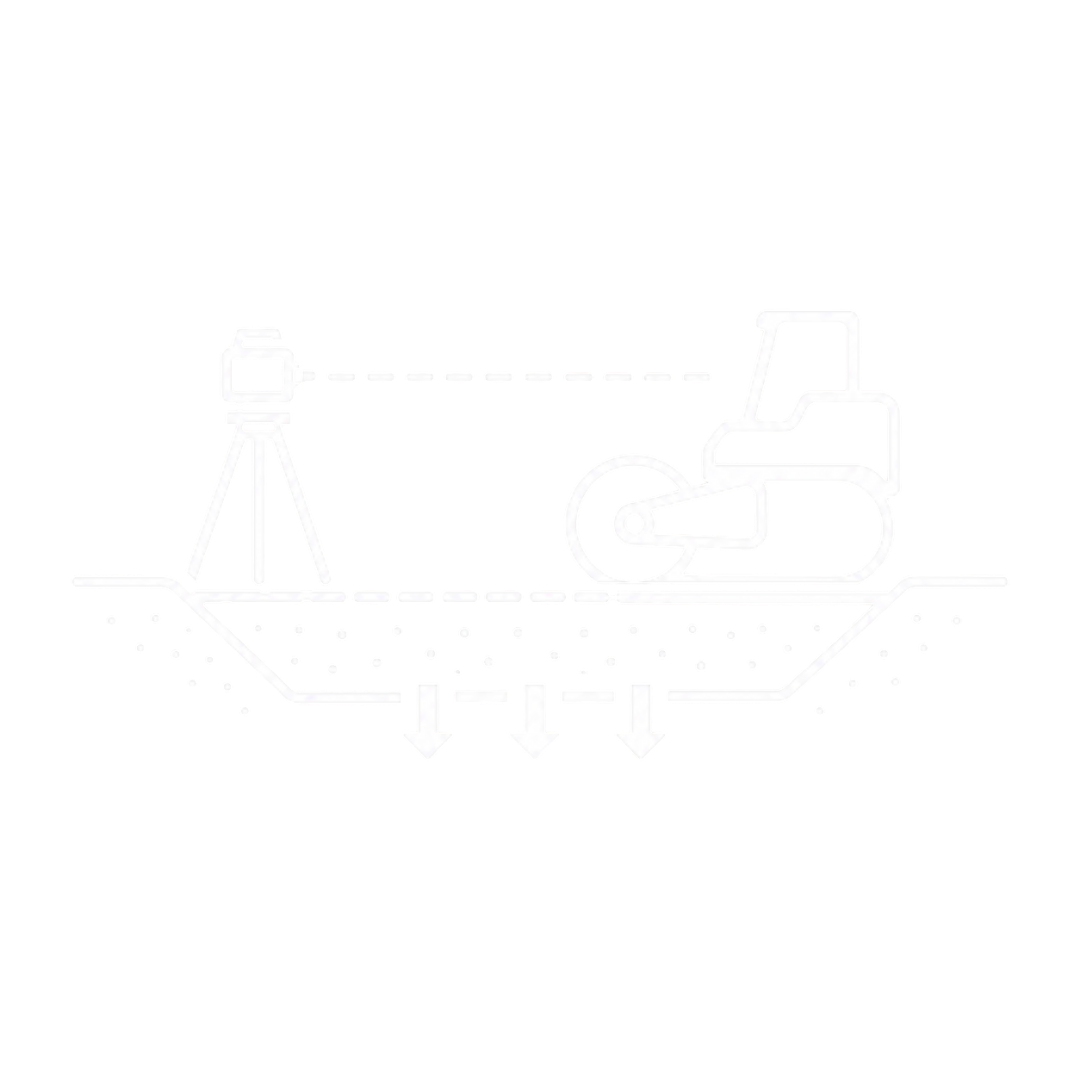
Mark the Line
The curb location and elevation are shot and strung along the roadway so the flowline stays true.
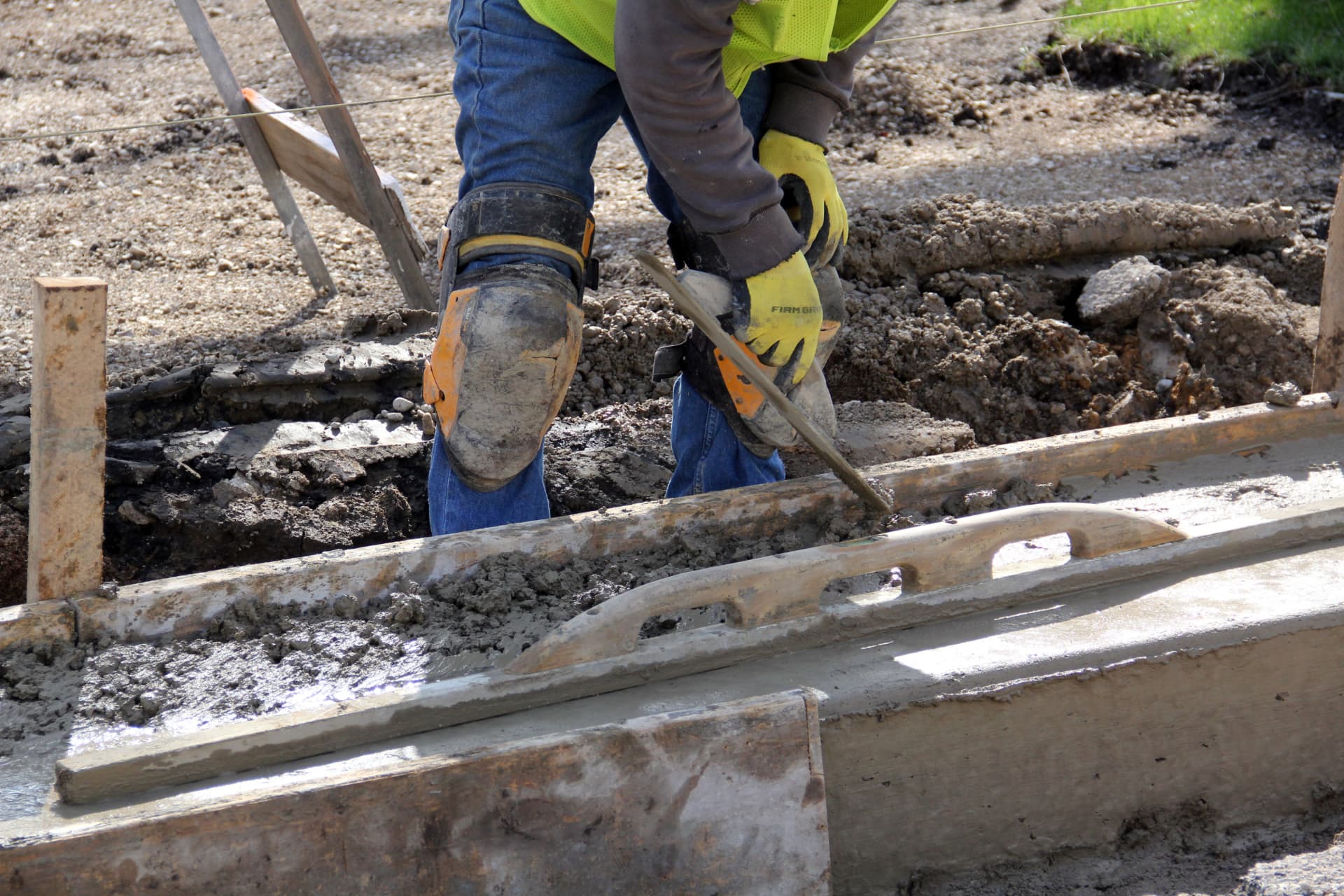
Curb and gutter is drainage infrastructure that happens to look like trim. If the flowline wanders, water pools in a parking lot and starts eating the asphalt edge and the pavement subgrade with it.
Most quotes back in 24 hours.
Curb and gutter is drainage infrastructure that happens to look like trim. Drag the timeline to see the full sequence — mark, excavate, compact, form, steel, pour, finish, and strip.
The curb location and elevation are shot and strung along the roadway so the flowline stays true.
Soil is removed along the curb-and-gutter path, creating a clean channel for the base and forms.
Aggregate base is placed in lifts and compacted to a firm, properly sloped bedding layer.
Vertical curb forms and the lower gutter channel are staked, braced, and checked to line.
Longitudinal rebar and dowels are positioned where the engineer's details call for reinforcement.
The curb and gutter are filled continuously so there are no cold joints in the flowline.
The curb face, gutter slope, edges, and control joints are formed before the concrete sets.
Forms come off and the finished section is left moving water exactly where it should go.
Straight runs, radii, and rolled curb matched to the existing profile on site.
Integral curb and gutter sections placed to a surveyed flowline.
Transitions into area inlets, valley gutters, and drive approaches.
Grades are shot and strung before placement, then checked again after so water actually reaches the inlet.
Saw-cut removal of failing sections and replacement that ties cleanly to what stays.
Curb and gutter looks like trim around a parking lot, but it's really drainage infrastructure. It defines where vehicles can go, holds the edge of the pavement together, and — most importantly — carries stormwater along a controlled path to an inlet instead of letting it spread across the lot and soak into the base.
We install and replace curb and gutter for commercial properties, retail centers, apartment complexes, HOAs, subdivisions and industrial sites throughout the San Antonio area. That includes standard barrier curb, rolled curb, integral curb and gutter, curb radii and islands, valley gutters, inlet transitions and drive approaches.
When curb work goes wrong, it usually shows up as water. A flowline that wanders even slightly leaves standing water in a parking lot, and that water works its way into the pavement edge and the base underneath it. Fixing pavement that's failing because of a bad curb line costs several times what the curb did.
Often handled alongside concrete sidewalk and walkway installation in San Antonio, site grading and compaction in San Antonio and concrete repair in San Antonio.
A consistent flowline moves runoff to the inlets instead of letting it pond in drive lanes and parking stalls.
Curb holds the edge of asphalt in place. Without it, edges ravel and break down from the outside in.
Curb lines, islands and radii keep vehicles where they belong and keep them off landscaping and sidewalks.
Water that never gets into the base doesn't undermine it, which means far fewer potholes and edge repairs down the road.
Straight, consistent curb lines and clean radii are one of the first things people notice about how a commercial property is kept up.
Curb creates a defined line between vehicle areas and walkways, islands and building fronts.
We look at the existing flowline, inlet locations and how water currently moves across the site before pricing anything.
For occupied properties, the estimate includes how the work gets phased so tenants and customers keep access during construction.
Existing curb is saw-cut and removed to clean joints, with the adjacent pavement protected and cut back where required.
The base under the curb is prepared and compacted, and grades are shot and strung so the flowline runs continuously to the inlet.
Curb is formed or slip-formed depending on the run, then placed, consolidated and finished to a consistent profile.
Joints are tooled, curb is backfilled behind so the edge is supported, and the site is swept clean before reopening the area.
Curb profile is easy to get consistent. Flowline elevation is what takes attention. A gutter pan with a flat spot or a slight reverse grade will hold water permanently, and it doesn't take much — a fraction of an inch over a long run is enough to leave a puddle that never fully drains.
That's why grades get shot before placement and verified again after, especially through radii, at inlet transitions and where new curb ties into existing curb that was built to someone else's elevations. Tying into existing work is where most flowline problems get created.
Details that matter on a curb and gutter project:
We work on commercial and residential development sites throughout San Antonio and the surrounding area, including Schertz, Cibolo, Converse, Universal City, Live Oak, Selma, Boerne, Helotes and New Braunfels.
Rain patterns here put curb work under real pressure. Long dry periods followed by intense rainfall mean a parking lot's drainage system has to handle a lot of water in a short window. Curb and gutter that only works in a light drizzle shows its problems the first time a heavy storm rolls through.
Public improvements and work in the right-of-way are typically subject to local standards and inspection. On projects that involve city or county requirements, we build to the specified detail and coordinate with the inspecting authority.
Yes. Failed sections are saw-cut out and replaced, tying into the existing curb at both ends. We check the flowline through the replacement so the new section doesn't create a low spot.
Barrier curb has a vertical face that discourages vehicles from crossing it. Rolled curb has a sloped face vehicles can drive over, which is common at residential driveways. Which one you need depends on the site and any applicable standards.
Usually only the section being worked on. We phase curb work so most of the lot stays open, and we give you a specific schedule for when the poured sections can carry traffic again.
Almost always a flowline problem — either the curb was placed without continuous fall to the inlet, or a section has settled. Correcting it means removing and re-placing the affected run to the right elevation.
Yes. Approaches, valley gutters, inlet transitions, islands and radii are all part of standard curb and gutter work, and they're the spots where getting the transition right matters most.
In most cases yes. We measure the existing profile on site so replacement sections line up with what stays instead of standing out.
Tell us about the property and what's failing, or send us the site plan for new construction. We'll walk the lot, check the drainage, and provide a written estimate with a phasing plan that keeps your property accessible.
Clean, ADA-conscious paths in San Antonio with proper slope and drainage.
View serviceLaser-checked grade and compaction for San Antonio sites that drains away from the build.
View serviceCut-and-replace, leveling, and joint repair on failing slabs.
View service
Tell us what you are building in the San Antonio area. We will walk the site, check soil, drainage, and access, and send a written scope you can actually compare against other bids.
Pick a time that works for you. We will come measure the site, check drainage and access, and send a written quote.